The moment the screen stops moving
There is a specific moment that sends people looking for a page like this one. Episode two ends mid-beat, the way these things always do, and instead of the next clip rolling on, everything holds still. What stopped it is a price. Candy AI attaches a token cost to every episode individually, and the first two on this series are set to zero while the third is set to thirty.
If you felt mildly played, you read it correctly. Two episodes at no cost is a sample cut to end where stopping is hardest, and the arithmetic underneath it is not hidden: thirty tokens buys the third, thirty more the fourth, thirty more the fifth.
What Student Bodies actually sets up
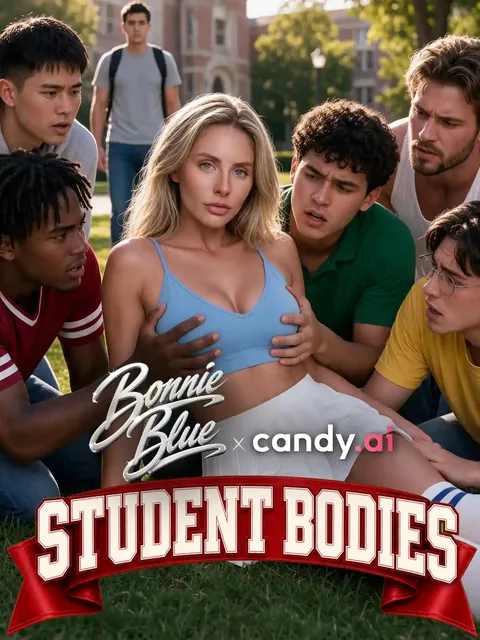
Bonnie Blue turns up at a university with a single day in front of her and a record attempt to get through, and the stream is running for all of it. That is the premise rather than a detail of it: everything happens in public, watched live by people who knew exactly what they were tuning in for.
What makes it a series instead of a clip is the student on the other side of the lens. He is there to hold the camera, he is plainly the least experienced person in the building, and across the five episodes the attention keeps sliding off the event and back onto him.
Two episodes of setup, three of payoff
Five episodes, and the same division every time. The pair that costs nothing is the establishing half: the arrival, the framing, the stream going live, the first hint that the man holding the camera matters more than he looks like he does. Suggestive throughout. Nothing explicit shown in either.
The third is where it turns NSFW, and where each episode starts costing thirty tokens. That is the entire mechanic, and there is nothing underneath it. No hidden sixth instalment, no alternate cut. How far any given series travels past that line varies, which is why this site rates that separately, one to five, printed alongside the page instead of argued for in the prose.
Bonnie Blue licensed her likeness, and that is the most interesting thing here
Most Candy Shorts series depict nobody. The characters are assembled out of nothing; there is no person standing behind them, nobody who could walk into a room and recognise their own face. A few are built differently, and this is one. Bonnie Blue is a real adult creator, she licensed her likeness to Candy AI for the series, and she is named for it, on the series itself rather than three menus deep in a settings page.
The two halves of that sentence collapse into each other the moment you stop paying attention, so keep them apart. The performer is real and she agreed. The footage is not footage. There was no campus, no crew, no day of production; the likeness was licensed and the episodes were generated from it.
Which makes this the precise inverse of a deepfake. A deepfake takes a face that never agreed, welds it onto material nobody sanctioned, and works hardest at hiding the seam. Here the face was given, the arrangement is the selling point rather than the thing being concealed, and the credit is the first thing you are shown. Same technology, opposite relationship: one is something done to a person, the other is something a person chose to license, roughly the way an actor lends a voice to a game character.
And where a Candy Shorts series names no creator, which is most of them, there is no real person in the frame at all.
The other series built the same way
This one is not alone. My Wife’s Best Friend carries Riley Reid’s name on identical terms: a real performer, a licensed likeness, generated episodes, and the same five-part run with the same free-then-paid division.
If the likeness question is what brought you here rather than this particular premise, the two still play very differently. One is organised around a public event with an audience living inside the story. The other is domestic, closed rooms, a small cast circling a situation before anyone will name it.
Who this one suits, and who should pick something else
Take it if the appeal is scale and spectacle: a premise public by design, an event unfolding in front of an audience, a camera nobody switches off. Take it too if the licensed-likeness question is the reason you are reading about Candy Shorts at all, because this is the series where that question is most legible.
Skip it if what you want from a short vertical story is two people, a closed door and tension accumulating slowly. The premise here is loud by construction. No misdirection, no quiet house, nobody pretending nothing is happening. If that is the register you were after, Date With My Stepmom and Got Stuck With My Girlfriend’s Stepmom are built on exactly that footing, and the catalogue is big enough that you never have to settle for the wrong one.
There is nowhere else to watch it
People search for this, so here it is straight: there is no leaked Candy Shorts material. Not for this series, not for any of them. The episodes exist inside Candy AI and nowhere beyond it, so the paid three are not sitting on a mirror waiting to be found, and any page promising otherwise is selling access to something that has never existed. The opening two carry a price of zero and play as they are. What they are not is the whole thing.