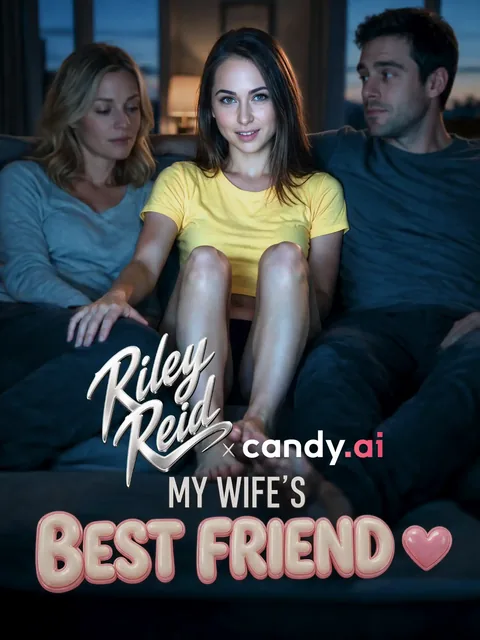
A spare room, a marriage, and a guest who is not a stranger
The setup is domestic before it is anything else. A woman his wife has known since long before the marriage needs somewhere to stay, and the spare room gets made up. A house built for two with three adults in it finds its rhythm fast: the kitchen at odd hours, the strange intimacy of a guest who has heard stories about you from the other side of the bed.
Her history is not treated as a secret. The character is written as an adult performer, the husband knows, she knows he knows, and his wife finds it unremarkable because to her it is. So it sits at the table with all three of them, fully acknowledged and never once mentioned, which is harder to live with than a secret.
Where the free half stops, and what each half is doing
The shape is the same across the catalogue. Five episodes, the opening two priced at zero and staying on the safe side of the line, suggestive the way a held glance is suggestive but showing nothing you would need to explain to somebody reading over your shoulder. The third is where it turns NSFW, and where each episode starts costing thirty tokens.
So the wall was not a malfunction. The opening pair is an introduction and a proximity exercise, priced at nothing precisely because it is the part meant to travel. Episodes three to five are where the premise is spent, and how far a series goes once it crosses that line varies across the catalogue, which is why this site scores each title from 1 to 5 and prints the number for this one at the top of the page.
Riley Reid licensed her likeness for this one
Read this section if you read nothing else. Almost everything in the Candy Shorts catalogue depicts no real human being: the faces are generated, assembled from nobody, with no person behind them to hold an opinion about what they are doing. A few series work differently. This is one.
Riley Reid licensed her likeness to Candy AI. Hold the two halves of that apart, because they get collapsed constantly and the difference is the point. The performer is real and she agreed. The footage is not. There was no set and no shoot; the face and the body are hers by arrangement, and everything you watch was generated from it. She consented to a likeness, not to a week of production.
That settles what people actually mean when they ask whether a series is real. Something real did happen here, and it was a signature rather than a camera. Where a Candy Shorts series names no creator, and most of them do not, nobody real is depicted at all.
When the role and the licence point at the same thing
Licensed likeness work usually asks the performer to be somebody else: the face is borrowed, the biography invented, and the two never meet. This series does the opposite, and that is why it earns a page of its own. The character is written as an adult performer, which is the work the woman who licensed the face actually did.
So the fiction never has to build a reason for her to be direct, unembarrassed, at ease in a house where she is making everyone else nervous. It reaches for the biography already attached to the likeness and uses it as characterisation. That gives the opening episodes a self-awareness little else here attempts: she is not a woman with a secret, she is a woman whose past is public record and long past interesting.
The caveat matters as much as the observation. It remains a written role. The dialogue was authored, the performance generated, the story somebody’s script. A likeness was licensed, not a life, and nothing across the five episodes should be read as Riley Reid’s view of anything.
The padlock, and why nothing is circulating
The division is not a matter of interpretation. In the page Candy AI serves, each episode of this series carries its own token price: nothing on the first two, thirty on each of the last three, which are marked premium. There is no bundle and no monthly tier in that arrangement. You buy an episode, and then you buy the next one.
The other half of that arrangement is where people lose evenings. There is no leaked Candy Shorts material. The episodes live inside Candy AI and nowhere else, so hunting for a mirror is hunting for something never let out of the building.
Who this one suits, and who should pick something else
This is your series if the licensed-likeness angle is genuinely what brought you here, and if you prefer a slow domestic build — a house, a routine, three people managing an awkwardness — to a scenario that opens at full volume. The self-aware framing is the distinguishing feature; if that does not appeal, nothing else will rescue it.
If it is the licence you want but a suburban house is not, two other titles are built the same way: Student Bodies uses Bonnie Blue’s likeness on a campus, and My Stepmom’s Weekend is Riley Reid again in a house emptied for a weekend. For married-household tension with nobody real attached, My Wife’s Personal Trainer covers similar ground with a fully generated cast. And the costume end of the catalogue — Cleopatra and Caesar, Dragon Queen’s Dark Desire — is there for anyone who wants nothing resembling real life.