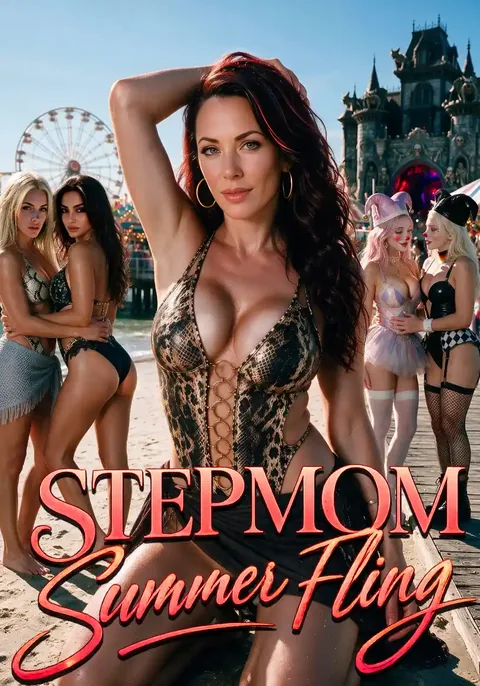
A house, a girlfriend who is not in it, and the woman who is
Most vertical adult serials drop two strangers into a frame and trust the frame to do the rest. This one starts from an obligation. The young man at the centre is somebody’s boyfriend, standing in his girlfriend’s family home with the posture of a man who knows he is being assessed. Then the doors shut, and whatever supplies the reason stops mattering: that was never the point.
The girlfriend need not appear at all for the premise to work. She is why nothing in that house can be simply friendly, why an offer of coffee arrives with a second meaning bolted on. A phone-shaped frame cannot hold two people at a polite distance.
A loyalty test, not a seduction
A seduction plot asks whether somebody will be wanted, and the resolution is a yes. This one runs on a different engine. The older woman is not principally trying to be persuasive — she is applying pressure to see what gives. The question is never whether he is tempted, but what he does while he is.
Instead of a negotiation between equals, you watch an examination run by the person holding every advantage: she is older, it is her house, she has a claim on a relationship he needs. He can refuse. Refusing is expensive, and she knows the price better than he does. She frames it as due diligence on her stepdaughter’s behalf rather than appetite of her own, and whether that framing survives is what the paid half settles.
The shape of the run: two open, three closed
Candy Shorts runs to five episodes a series, and the five are not equal slices. The split is two and three. The opening pair costs nothing and shows nothing explicit — suggestive, certainly, that being the point, but safely on the near side of the line. Their job is establishment: who this man is to this family, and the moment the older woman decides to act.
With the third episode the register changes and the series becomes adult content, and those three are the ones you pay for. You are not being sold a bonus scene stapled to a free story. The free part is the opening two-fifths of a five-part shape, stopping exactly where setup ends and consequence starts.
What the padlock is
The wall is a price tag, and Candy AI prints it in the page itself. Every episode of this series carries a token cost: zero on the first two, twelve on each of the three that follow. Nothing is being withheld from you. The third episode is simply for sale, and so are the two after it.
Two episodes at no cost is a measured sample rather than a generous one, cut to finish on the beat where stopping is hardest to accept. That is a commercial decision, not a hidden one, and the thirty-six tokens that finish the run are the price of the decision you are being invited to make. Which makes the decision cleaner, not worse: you already know what you thought of the story.
Nobody in this one is a real person
Everything under the Candy Shorts banner is generated. Inside that, one distinction matters: six titles were made with an adult creator who licensed her likeness: Bonnie Blue, Riley Reid on three of them, Sophie Dee and Mia Malkova. There a real woman agreed to the arrangement and is credited for it, and the footage is generated all the same.
This is not one of those. No creator is attached to it, so the stepmother is a likeness of nobody: no performer to look up, no filmography behind her, no account to follow afterwards. If what you want is knowing a real human being chose to be there, the two above are the right titles and this is not. If you would rather it stay unambiguously invented, the absence here is not a gap. It is the point.
Who this suits, and who should pick a different title
Choose it if the appeal is the situation rather than the spectacle: a closed set, a short cast, an obligation in the middle of the room that nobody can put down. That he has something to lose carries more of this premise than anything else.
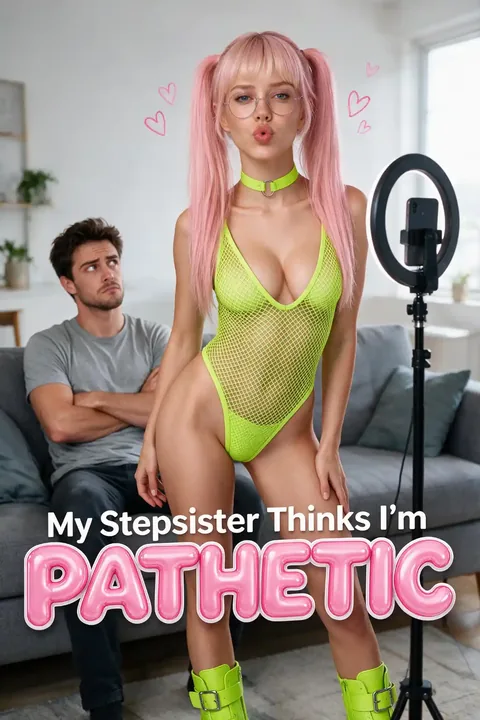
Choose differently if you want a face you recognise — six series are built around a licensed likeness, from Student Bodies through to Under Her Watch and Private Lessons. Choose differently if you want the older-woman setup without the loyalty pressure: Date With My Stepmom covers adjacent ground, but it runs on a grievance aimed at an absent husband, so it plays as score-settling rather than examination. Choose differently if you want noise and speed, which is My Stepsister Thinks I’m Pathetic.
And choose differently if you need the paid episodes to travel a particular distance. That varies, so our one-to-five score lives in the rating box on this page rather than in the prose around it.